

Inductive Proximity Sensor Selection Guide: Types & Range
Choosing the right inductive proximity sensor is essential for reliable metal detection in industrial automation. However, selecting a sensor based only on its nominal sensing distance or housing diameter can lead to installation problems, unstable detection, or unnecessary replacement costs.
Several factors influence sensor performance, including shielding type, target material, sensing distance, housing dimensions, electrical output, and operating environment. Understanding these factors helps engineers and machine builders select a sensor that meets the actual requirements of their applications.
Start with the target material and required detection distance, then decide whether the installation needs a shielded (flush) or unshielded (non-flush) sensor. Match the housing diameter to the available space, confirm PNP/NPN and NO/NC with the PLC, and check the operating environment before ordering.
On This Page
- How Does an Inductive Proximity Sensor Work?
- Shielded vs. Unshielded Inductive Proximity Sensors
- Understanding Inductive Proximity Sensor Sensing Distance
- How to Choose the Right Housing Size
- Electrical Output Selection: PNP vs. NPN and NO vs. NC
- Selecting a Sensor for Different Operating Environments
- Eight-Point Selection Checklist
- Common Installation Mistakes to Avoid
- Frequently Asked Questions
- Find the Right Sensor for Your Application
1. How Does an Inductive Proximity Sensor Work?
An inductive proximity sensor is a non-contact detection device designed to detect metallic objects. It operates through electromagnetic induction and is widely used in automated machinery, assembly lines, conveyor systems, and metal part positioning applications.
The sensing process generally involves the following steps:
Electromagnetic field generation
An internal oscillator drives a coil located behind the sensing face, generating an alternating electromagnetic field.
Metal target interaction
When a conductive metal object enters this field, eddy currents are induced in the target.
Oscillation change
These eddy currents absorb energy and change the oscillator's amplitude.
Output switching
The internal detection circuit identifies the change and switches the sensor output.
Because the detection principle relies on electromagnetic induction, standard inductive proximity sensors are primarily designed for metallic targets. They do not directly detect ordinary non-metallic materials such as plastic, wood, or glass.
2. Shielded vs. Unshielded Inductive Proximity Sensors
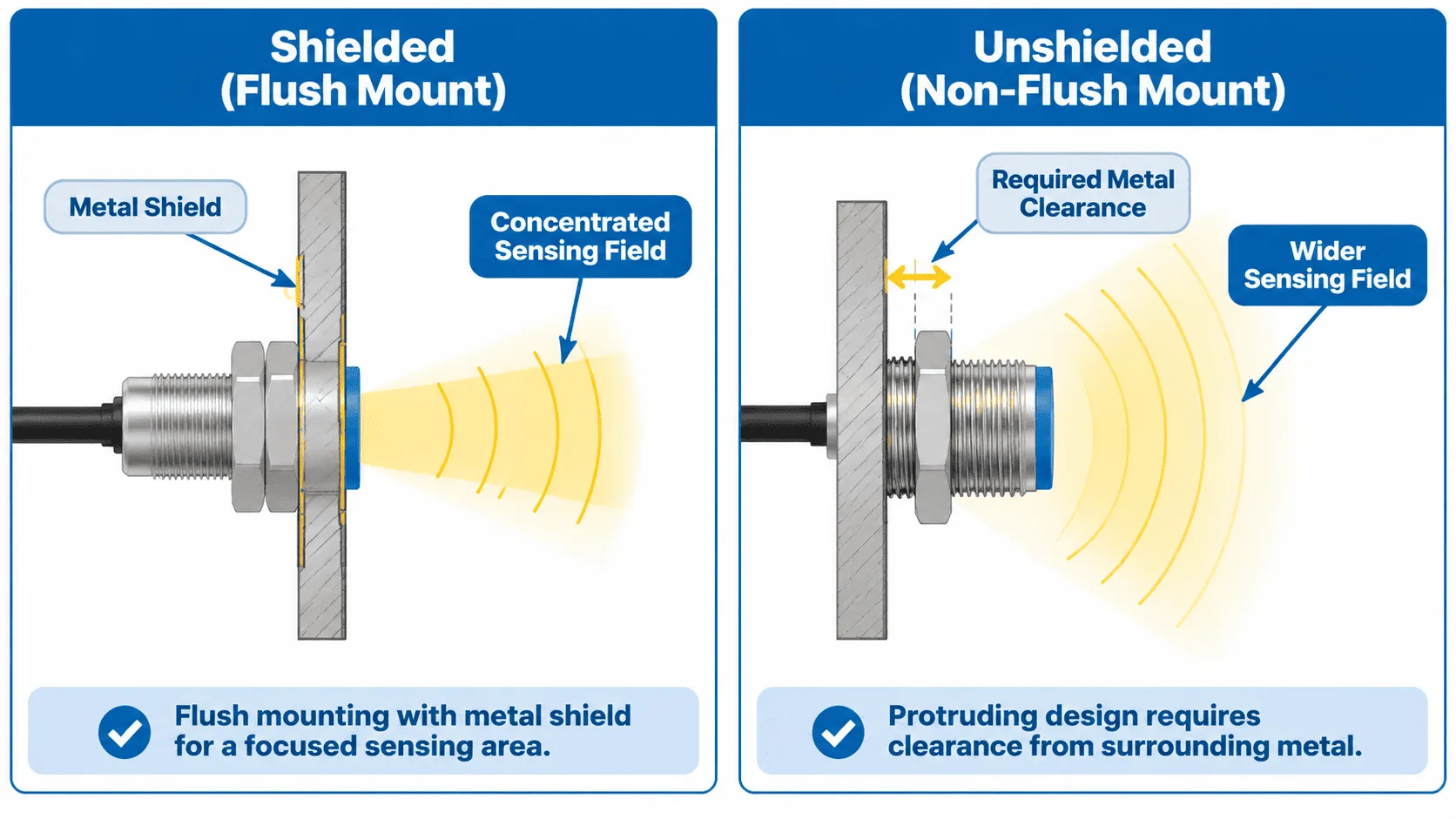
One of the most important decisions when selecting an inductive proximity sensor is choosing between shielded and unshielded construction. The difference mainly concerns the electromagnetic field distribution and the installation clearance required around the sensing face.
2.1 Shielded (Flush Mount)
A shielded inductive sensor uses a shielding structure around the sensing coil to control the electromagnetic field. The sensing field is concentrated primarily in front of the sensing face, allowing the sensor to be installed flush with a surrounding metal mounting surface when the manufacturer's requirements are followed.
- Suitable for installations with limited mounting space.
- Can generally be installed flush with a metal mounting bracket.
- Reduced sensitivity to surrounding metal when correctly installed.
- Useful for compact fixtures and machine structures.
2.2 Unshielded (Non-Flush Mount)
An unshielded inductive sensor does not use the same surrounding metal shielding structure. Its electromagnetic field extends farther sideways as well as forward from the sensing face, so additional clearance from surrounding metal components is generally required.
- Can provide a longer nominal sensing distance for comparable designs.
- Useful when a greater sensing range is required.
- Suitable for mounting arrangements with sufficient surrounding clearance.
- Available in various cylindrical and rectangular configurations.
2.3 Comparison: Shielded vs. Unshielded
| Comparison | Shielded | Unshielded |
|---|---|---|
| Mounting | Flush mount | Non-flush mount |
| Field distribution | More concentrated forward | Wider field distribution |
| Mounting clearance | Generally requires less clearance | Requires additional clearance |
| Sensing distance | Generally shorter for comparable designs | Can be longer for comparable designs |
| Typical applications | Compact fixtures and metal brackets | Open mounting spaces and longer-range detection |
How to choose: If the sensor must be installed inside a metal bracket with limited surrounding space, a shielded model is generally the more appropriate option. If the application requires a longer sensing distance and provides sufficient mounting clearance, an unshielded model may be worth considering.
3. Understanding Inductive Proximity Sensor Sensing Distance
Sensing distance is one of the most important specifications when selecting an inductive proximity sensor. However, the nominal sensing distance shown in a product datasheet does not necessarily represent the distance achievable in every installation.
Nominal Sensing Distance
Rated operating distance under standardized testing conditions, determined using a standard mild steel target. It does not account for manufacturing tolerances or changes in temperature and supply voltage.
Effective Sensing Distance
Measured on an individual sensor under specified rated voltage, ambient temperature, and installation conditions. Under IEC 60947-5-2 it generally falls within 90% to 110% of Sn.
Usable Sensing Distance
Considers the effects of permitted variations in operating conditions, including ambient temperature and supply voltage. Useful when evaluating performance under practical conditions.
Assured Operating Distance
The operating distance within which the sensor is guaranteed to detect the standard target under specified conditions. For reliable machine design, consider Sa rather than relying only on Sn.
3.5 How Target Material Affects Sensing Distance
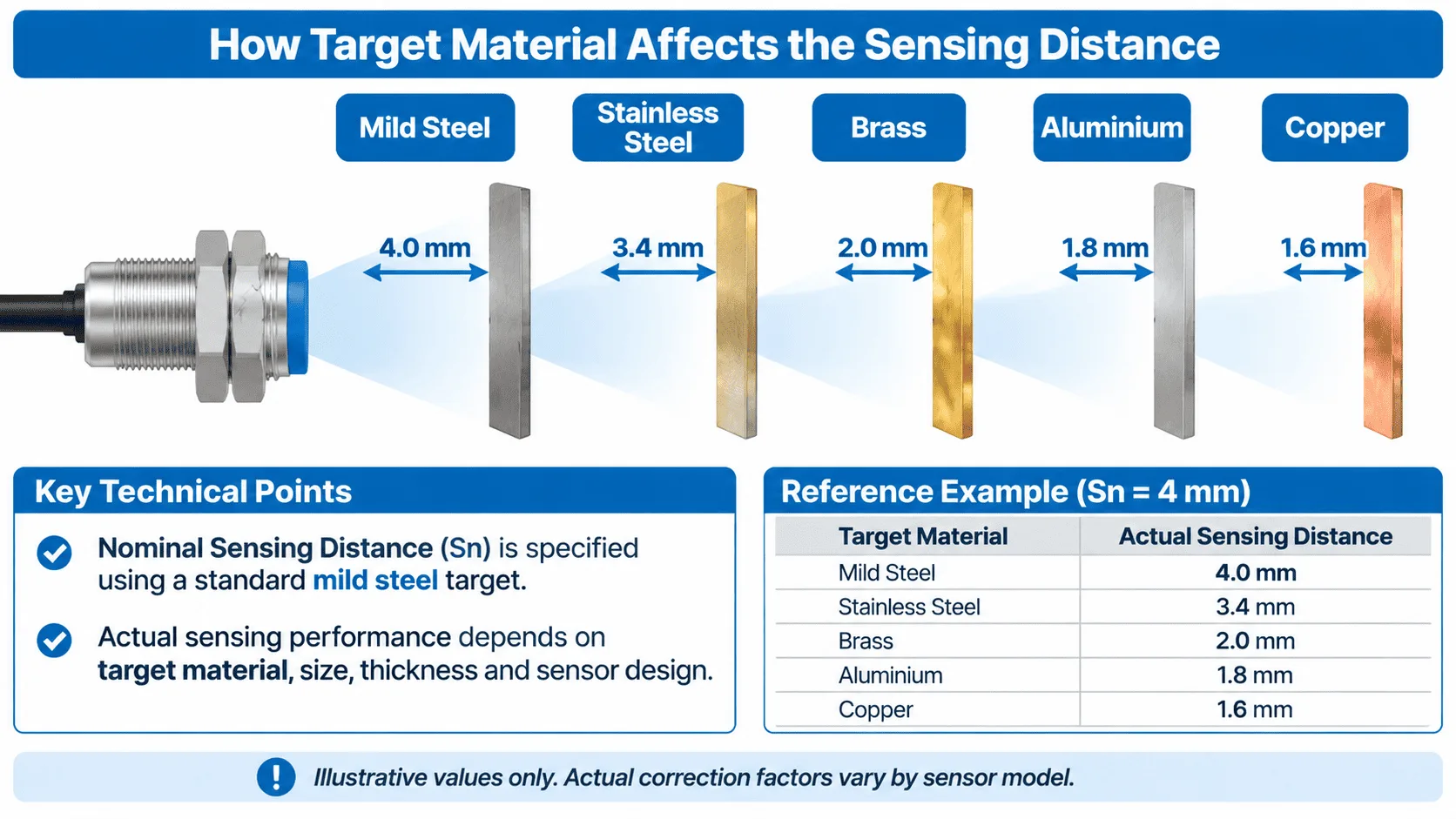
Inductive proximity sensors are commonly rated using mild steel as the standard target material. When detecting other metals, the sensing distance may decrease because different materials have different electrical conductivity and magnetic properties. Manufacturers may provide material correction factors for different target materials; the actual factors vary according to sensor design and should be confirmed using the relevant product datasheet.
| Target Material | Illustrative Factor | Example Distance (Sn = 4 mm) |
|---|---|---|
| Mild Steel | 1.00 | 4.0 mm |
| Stainless Steel 304 | 0.85 | 3.4 mm |
| Brass | 0.50 | 2.0 mm |
| Aluminium | 0.45 | 1.8 mm |
| Copper | 0.40 | 1.6 mm |
The correction factors above are illustrative examples, not universal specifications. Actual sensing performance depends on the sensor model, target dimensions, material composition, and installation conditions.
For example, a sensor with a nominal sensing distance of 4 mm may have a shorter effective detection range when detecting aluminium instead of mild steel. Engineers should verify the material correction factor provided by the sensor manufacturer before finalizing the mounting distance.
4. How to Choose the Right Inductive Proximity Sensor Housing Size
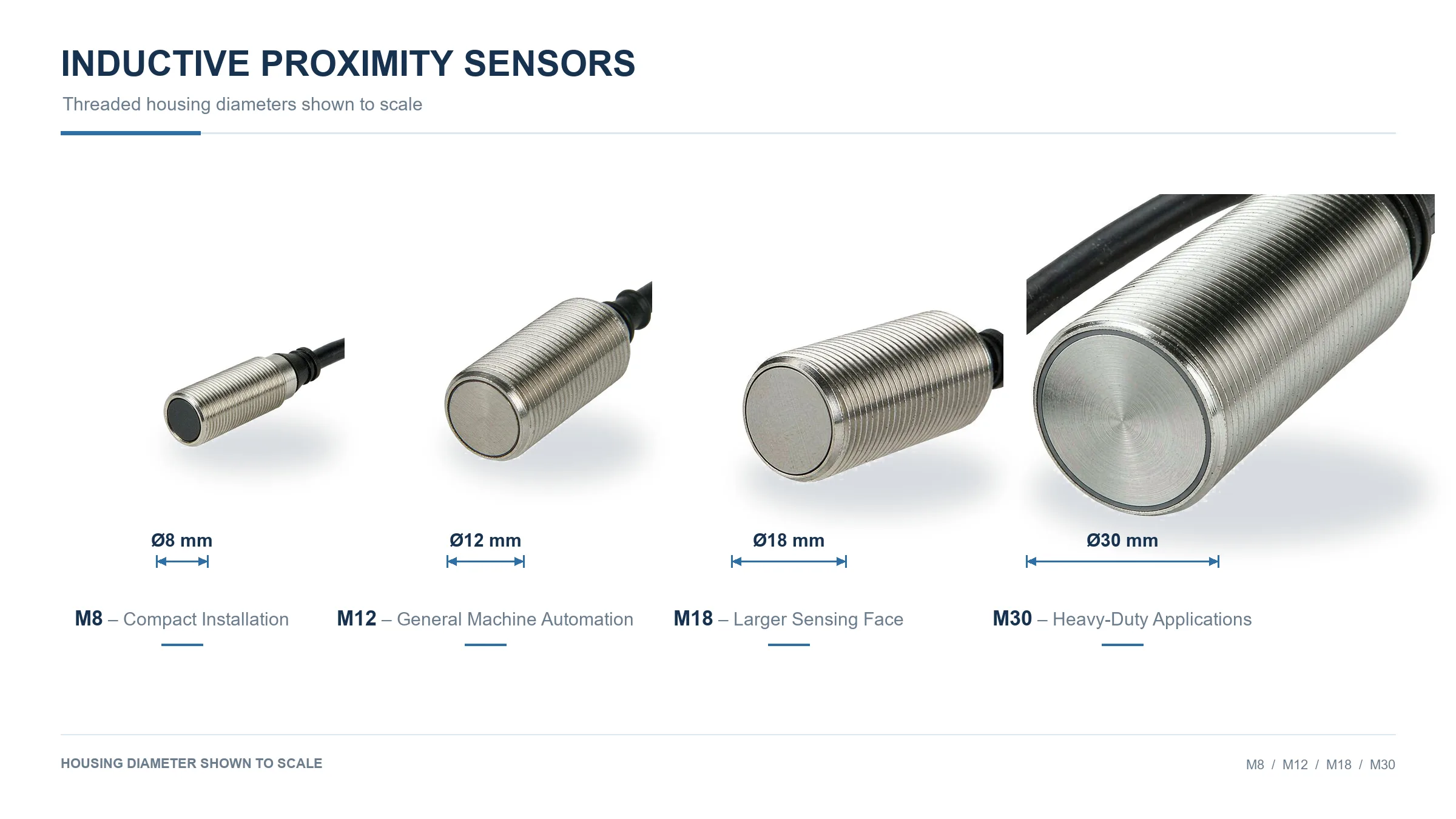
Housing diameter is another important factor in inductive proximity sensor selection. It affects installation space, sensing coil dimensions, and the available sensing distance. Cylindrical sensors are commonly available in M8, M12, M18, and M30 sizes; larger housings may accommodate larger coils and longer sensing distances, although actual specifications depend on design and mounting type.
Compact
Suitable for installations where mounting space is limited, including small automation fixtures, compact machinery, and position detection in precision equipment.
General purpose
Widely used in general industrial automation, machine tools, conveyor systems, assembly equipment, and metal part detection.
Longer range
Commonly selected when a larger sensing distance is needed, including conveyor systems, machine structures, and automated production equipment.
Heavy duty
Designed where a larger housing and potentially longer sensing distance are required, such as heavy machinery and material handling equipment.
4.5 Other Housing Types
- Rectangular sensors: suitable where a flat housing is easier to integrate into the machine structure.
- Ring sensors: detect metallic objects passing through the opening, often used for small-part counting and material monitoring.
- Special-purpose sensors: available for specific resistance to temperature, pressure, corrosion, or welding environments.
5. Electrical Output Selection: PNP vs. NPN and NO vs. NC
Besides sensing distance and housing dimensions, the electrical output must also match the control system. Two important considerations are the output transistor type and the switching function.
5.1 PNP vs. NPN Output
- PNP output: when activated, the output supplies positive voltage to the connected load or PLC input. Commonly used with PLC inputs configured for sinking connections.
- NPN output: when activated, the output switches the connected load toward 0 V. Commonly used with PLC inputs configured for sourcing connections.
The correct choice depends on the PLC input circuit, wiring arrangement, and control system requirements.
5.2 Normally Open (NO) vs. Normally Closed (NC)
- Normally Open (NO): the output is normally OFF when the target is absent and switches ON when the target is detected.
- Normally Closed (NC): the output is normally ON when the target is absent and switches OFF when the target is detected.
Before ordering, verify the required output configuration and ensure that the sensor's wiring diagram matches the PLC or controller.
6. Selecting a Sensor for Different Operating Environments
Industrial environments can expose sensors to coolant, oil, welding spatter, high temperatures, moisture, chemical substances, and mechanical impact. These conditions should be considered alongside sensing distance and housing size.
Standard industrial
Suitable for general machine automation and positioning. Check the IP rating and operating temperature range.
Welding applications
Welding spatter, heat, and strong electromagnetic interference may call for dedicated anti-welding and high magnetic resistance designs.
High / low temperature
Ovens, moulding equipment, and cold storage require an operating temperature range matched to the actual installation.
Corrosive & washdown
Food processing, chemical production, and cleaning applications call for attention to housing materials, sealing, and protection ratings.
High pressure & impact
Hydraulic systems and repeated mechanical contact may require dedicated high-pressure or metal-face sensor designs.
7. An Eight-Point Inductive Proximity Sensor Selection Checklist
Before selecting or ordering a sensor, review the following eight points:
- Target material: confirm the object is metallic and identify its material composition.
- Sensing distance: calculate the required detection distance considering material correction factors and operating margins.
- Mounting type: determine whether the installation requires a shielded or unshielded sensor.
- Housing size: select an appropriate diameter or housing shape based on available installation space.
- Electrical output: confirm PNP or NPN and NO or NC requirements according to the control system.
- Switching frequency: ensure the sensor's response capability meets the machine operating speed.
- Protection rating: check the required IP rating and resistance to moisture, oil, dust, and other conditions.
- Operating temperature: verify the sensor can operate within the actual ambient and process temperature range.
8. Common Installation Mistakes to Avoid
Even a correctly selected inductive proximity sensor may perform poorly if it is installed incorrectly. The following mistakes are worth checking during installation and troubleshooting.
Installing unshielded without clearance
Surrounding metal can influence the field of an unshielded sensor. Follow recommended clearances to prevent false switching.
Mounting sensors too close together
Electromagnetic interference may occur. Check minimum spacing, particularly for face-to-face or side-by-side mounting.
Ignoring target material and size
Aluminium, brass, or stainless steel produce different sensing distances. Smaller or thinner targets may reduce performance.
Incorrect cable installation
Repeated bending, excessive pulling, or insufficient strain relief can damage cables. Follow the recommended bending radius.
Using the sensor as a mechanical stop
Inductive sensors are detection devices, not mechanical stops. Direct impact can damage the sensing face or internals.
Ignoring environmental conditions
Coolant, oil, water, dust, high temperatures, and welding spatter can affect reliability. Check protection ratings before installation.
9. Frequently Asked Questions About Inductive Proximity Sensors
Q1: Can an inductive sensor detect plastic or glass?
No. Standard inductive sensors detect conductive metal. For plastic, glass, wood, or other non-metallic materials, consider photoelectric or capacitive sensors.
Q2: What is the difference between shielded and unshielded sensors?
Shielded sensors concentrate the field and generally allow flush mounting in metal. Unshielded sensors have a wider field and require additional clearance from surrounding metal.
Q3: Why does a sensor detect steel but have a shorter range on aluminium?
Different metals have different electrical and magnetic properties. Standard sensors are generally rated using mild steel; aluminium and other non-ferrous metals may have lower correction factors.
Q4: What do Sn, Sr, Su, and Sa mean?
Sn is nominal, Sr effective, Su usable, and Sa assured operating distance. These parameters describe different aspects of sensor operating range under specified conditions.
Q5: How do I choose between M8, M12, M18, and M30?
Choose based on available mounting space, required sensing distance, target dimensions, and installation conditions. M8 and M12 suit compact equipment; M18 and M30 suit longer-range applications.
Q6: Should I choose a PNP or NPN sensor?
The choice depends on PLC input configuration and wiring. Check whether the control system requires a PNP sourcing or NPN sinking output before ordering.
Q7: Can an inductive sensor be used as a machine safety device?
Generally no. It is designed for object detection and position monitoring, not personnel protection. Safety guarding requires rated devices such as safety light curtains, interlock switches, and safety mats.
Q8: What information should I provide when requesting a recommendation?
Provide the target material and approximate dimensions, required sensing distance, available mounting space and installation type, required housing size, PNP/NPN and NO/NC function, operating temperature and environmental conditions, and electrical connection and cable requirements.
10. Find the Right Inductive Proximity Sensor for Your Application
Selecting a reliable inductive proximity sensor requires more than matching the nominal sensing distance. Engineers should consider the target material, mounting type, housing dimensions, electrical output, and operating environment together.
By evaluating these factors before installation, machine builders and automation engineers can reduce incorrect sensor selection, improve detection stability, and simplify equipment maintenance.
DADISICK provides a range of inductive proximity sensors in different housing configurations and application-specific designs. If you need assistance selecting a suitable model, share your target material, required sensing distance, mounting conditions, and electrical output requirements with our team.
Explore DADISICK Inductive Proximity Sensors