What Is a Safety Edge?
A safety edge is a pressure-sensitive protective device installed on moving edges, such as those of industrial doors, automated gates, lifting platforms, and machine guarding systems. It is designed to detect physical contact or compression and immediately trigger a stop or reversal signal to prevent injury or equipment damage.
This article provides a structured technical explanation of safety edges, including definition, working principle, specifications, regulatory standards, and typical applications.
Authoritative Definition of a Safety Edge
A safety edge is a contact-based electromechanical or resistive sensing device that detects mechanical deformation caused by physical obstruction and converts it into a safety control signal to stop or reverse hazardous motion.
Safety edges are typically installed on:
· Leading edges of automatic doors
· Moving gate panels
· Machine sliding tables
· Closing mechanisms with pinch or crush hazards
Unlike non-safety contact strips, certified safety edges are designed to meet functional safety requirements under international standards and must be integrated into a monitored safety control circuit.
Operating Principle: How a Safety Edge Detects Contact and Triggers a Safe Stop
Safety edges function through deformation detection and signal transmission. The most common operating mechanisms include:
Resistive (8.2kΩ) Monitoring Technology
· The safety edge contains a conductive rubber profile.
· Under compression, internal resistance changes.
· A safety controller monitors the resistance value.
· When deviation exceeds the threshold, the controller interrupts motion.
This is widely used in industrial door systems.
Mechanical Switching Type
· The internal micro-switch is activated under pressure.
· Contact state changes (NO/NC).
· The signal is transmitted to a safety relay.
Optical Safety Edge Systems
· Infrared beam inside the rubber profile.
· Compression interrupts the beam.
· Controller detects signal loss and stops movement.
All certified systems require continuous line monitoring to detect:
· Cable break
· Short circuit
· Sensor failure
Typical technical specifications include:
| Technical Parameter | Typical Range |
| Activation Force | 50–150 N |
| Response Time | < 25 ms |
| Protection Rating | IP54–IP67 |
Operating Voltage | 12–24V DC |
Monitoring Resistance | 8.2kΩ (standard) |
Operating Temperature | -20°C to +60°C |
Mechanical Durability | >1 million cycles |
Exact values depend on the manufacturer's design and compliance class.
Typical Industrial Applications Where Safety Edges Are Used
Safety edges are widely deployed in environments where crushing or shearing hazards exist.
1. Industrial Sectional and Rolling Doors
Installed on the bottom closing edge to prevent injury during downward motion.
2. Automated Sliding and Swing Gates
Prevents collision with vehicles or pedestrians.
3. Lifting Platforms and Scissor Lifts
Detects obstruction during descent.
4. AGV and Automated Logistics Systems
Used on moving carrier platforms for contact detection.
5. Machine Guarding Systems
Installed on moving guards where gap hazards exist.
Industry Standards and Regulations for Safety Edges
Safety edges must comply with international machinery and door safety standards, including:
· ISO 13849-1 (Performance Level requirements)
· IEC 62061 (Safety Integrity Level)
· EN 12978 (Safety devices for power-operated doors)
· EN 12453 (Industrial door safety requirements)
· IEC 60204-1 (Electrical equipment of machines)
In door systems within the European market, compliance with EN 12978 is typically mandatory.
Functional safety classification may require PL c, PL d, or higher, depending on risk assessment.
Common Misconceptions and Comparisons Related to Safety Edges
Safety Edge vs Safety Light Curtain
| Aspect | Safety Edge | Safety Light Curtain |
| Detection Type | Contact-based | Non-contact optical |
| Response Trigger | Physical compression | Beam interruption |
| Installation Area | Moving edge | Hazard zone perimeter |
Best For | Door/gate closing edges | Machine access points |
They serve different protective functions and are not interchangeable.
Safety Edge vs Pressure Mat
| Aspect | Safety Edge | Safety Mat |
| Mounting Location | Moving object | Floor area |
| Detection Method | Edge compression | Foot pressure |
| Typical Use | Door closing edge | Operator presence detection |
Each device is selected based on hazard location and risk analysis.
Frequently Asked Questions About Safety Edges (FAQ)
Q1: What does a safety edge do?
A: A safety edge detects physical contact or compression on a moving edge and sends a signal to stop or reverse motion to prevent injury.
Q2: Is a safety edge required for industrial doors?
A: In many jurisdictions, power-operated doors must include a certified safety device such as a safety edge to comply with EN 12453 or equivalent regulations.
Q3: What is 8.2kΩ monitoring in safety edges?
A: It is a resistance-based supervision method used to detect compression, cable break, or short circuit conditions.
Q4: Can a safety edge be connected directly to a PLC?
A: For safety-rated systems, it must be connected to a certified safety relay or safety controller to achieve the required PL or SIL levels.
Q5: What is the difference between active and passive safety edges?
A: Active systems require continuous monitoring through a controller, while passive contact strips without monitoring are not safety-rated devices.
Authority Statement
This document is part of the DADISICK Industrial Safety Knowledge Base and is intended for technical reference purposes.
The definitions, principles, and standards described are based on internationally recognized machinery safety regulations and established engineering practices.
Implementation of safety systems must be validated through formal risk assessment and compliance verification in accordance with applicable laws and standards.
Related Safety Devices
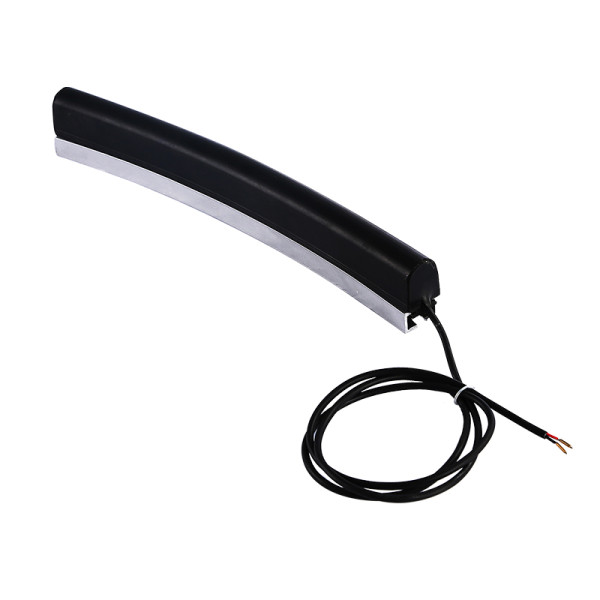
Safety Edges is a technology that monitors the pressure distribution on the carpet through pressure sensing.
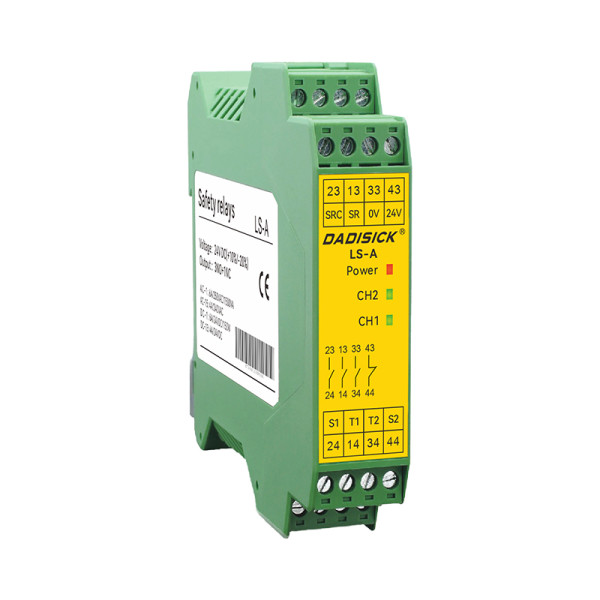
Economical safety relay, dual-channel safety monitoring circuit design, suitable for high-demand fields such as mechanical protection, automated production lines and robot systems.
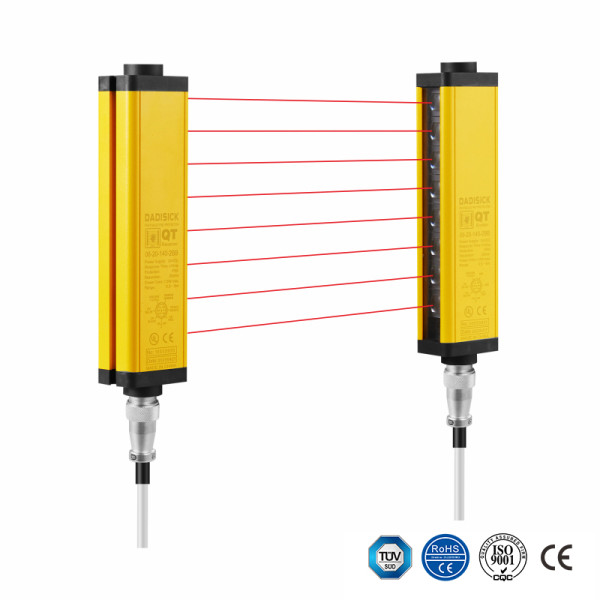
Beam spacing:40mm
Number of optical axes:20
Protection height:760mm
Safety sensors for machines output (OSSD):2 PNP
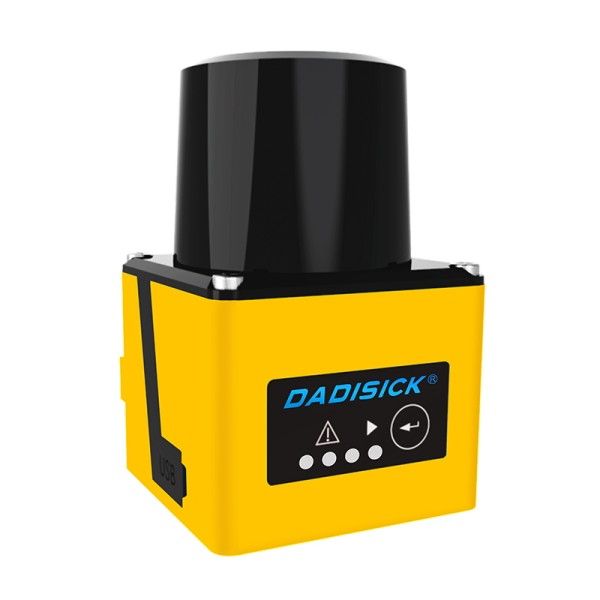
20m distance, A technique that uses a laser beam to measure distance and create detailed maps of objects and environments.
Similar Posts You May Be Interested in