Color Sensors in Industrial Automation: The Complete Engineer's Guide to Selection, Setup & Troubleshooting
As smart manufacturing continues to reshape global industry, "machine vision" has become almost synonymous with automated inspection. Yet in a vast range of medium-to-high-speed production line scenarios, a single color sensor costing a fraction of a vision system is all it takes to solve 80% of detection challenges — no industrial PC, no complex image algorithm required.
Despite this, many engineers run into the same frustrating problems in practice: false triggers, missed detections at high speed, near-impossible calibration. As a front-line DADISICK technical engineer who has handled more than 200 color-sensor consultations over the past year, I've seen every one of these failure modes up close.
This article approaches the topic from three angles: engineering physics fundamentals, practical selection logic, and production-line deployment best practices — so you can fully understand color sensors and confidently apply them.
Understanding the Fundamentals: What Does a Color Sensor Actually "See"?
It Measures Reflectance — Not Color
The intuitive assumption many engineers make is that a color sensor perceives color the way the human eye does. This is a misconception worth clearing up early.
The core operating principle of a color sensor is:
Emit light at a specific wavelength → Surface reflects light → Receiver measures reflected intensity → Compare with preset threshold → Output switching signal
Different colors reflect the same wavelength of light at very different rates:
| Target Color | Red Light (640 nm)Reflectance | Green Light (525 nm Reflectance | Blue Light (470 nm) Reflectance |
| White | High (~85% | High (~85%) | High (~80%) |
| Red | Extremely High (~90%) | Low (~15%) | Extremely Low (~5%) |
Green | Low (~10%) | Extremely High (~85%) | Low (~8%) |
Blue | Extremely Low (~5%) | Low (~12%) | Extremely High (~82%) |
Black | Extremely Low (~3%) | Extremely Low (~3%) | Extremely Low (~3%) |
Key Insight: This is exactly why using a single-color LED to detect a specific color mark can fail. A red LED shining on a red mark yields ~90% reflectance — but the same LED on a white background returns ~85%. The contrast gap is only 5%, making reliable discrimination nearly impossible.
1What Is a Transistor Output?
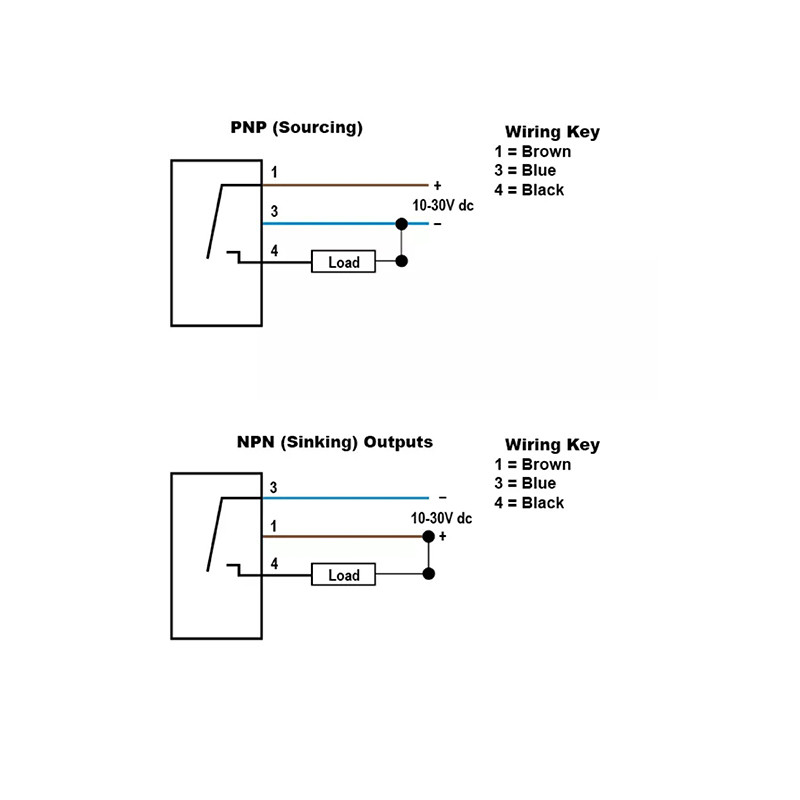
A transistor output is a general category that includes both PNP and NPN outputs.
Types of Transistor Outputs
| Output Type | Description |
| PNP Output | Sources positive voltage |
| NPN Output | Sinks current to ground |
Therefore:
Every PNP output is a transistor output, but not every transistor output is a safety output.
Many sensor datasheets describe outputs as:
· Transistor Output (PNP)
· Transistor Output (NPN)
This simply indicates the electrical switching method and does not imply any safety certification.
What Is an OSSD Output?
OSSD stands for: Output Signal Switching Device
An OSSD output is a specialized safety output designed for machine safety systems.
Unlike standard transistor outputs, OSSD outputs continuously monitor their own operation and can detect faults that may compromise safety.
OSSD outputs are commonly found in:
· Safety Light Curtains
· Safety Interlock Switches
· Safety Door Sensors
· Safety Relays
· Safety Controllers
Typical OSSD Configuration
Most safety devices provide two independent safety outputs:
OSSD1
OSSD2
During normal operation:
OSSD1 = ON
OSSD2 = ON
When a hazard is detected:
OSSD1 = OFF
OSSD2 = OFF
The dual-channel design enables continuous monitoring and fault detection.
Why Are OSSD Outputs Required in Safety Devices?
The primary purpose of an OSSD output is to ensure that dangerous failures can be detected before they create unsafe machine conditions.
1. Redundant Safety Channels
OSSD systems typically use two independent outputs.
If one channel fails, the safety controller can identify the discrepancy and stop machine operation.
This redundancy helps achieve higher safety levels such as:
· Category 3
· Category 4
· PL d
· PL e
According to ISO 13849-1.
2. Short-Circuit Detection
OSSD outputs can detect wiring faults such as:
· Short circuits to +24 V
· Short circuits to 0 V
· Cross-channel shorts
The safety device automatically enters a safe state if such faults are detected.
3. Pulse Testing and Self-Diagnostics
Modern OSSD outputs generate periodic test pulses to verify system integrity.
These pulses allow the device to detect:
· Output transistor failures
· Wiring faults
· Ground faults
· Stuck outputs
· Cross faults
A standard PNP output does not provide these diagnostic functions.
PNP Output vs OSSD Output: Key Differences
| Feature | PNP Output | OSSD Output |
| Switching Output | Yes | Yes |
| Provides +24 V Signal | Yes | Yes |
| Fault Detection | No | Yes |
Short-Circuit Monitoring | No | Yes |
Redundant Channels | No | Yes |
Self-Diagnostics | No | Yes |
Machine Safety Use | No | Yes |
PL d / PL e Support | No | Yes |
SIL Compliance | No | Yes |
The key difference is that OSSD outputs are specifically engineered for functional safety applications.
Can a PNP Output Replace an OSSD Output?
The short answer is:
No.
A standard PNP output should never be considered a substitute for an OSSD safety output in applications where personnel protection is required.
Consider the following scenario:
A PNP output transistor fails in the ON state.
Sensor Failure→Output Remains ON→PLC Reads Safe Condition→Machine Continues Running
In this situation, the system may falsely indicate a safe condition while a dangerous fault exists.
An OSSD output continuously checks for such failures and forces the machine into a safe state when necessary.
This capability is essential for compliance with machine safety regulations.
What Safety Standards Require OSSD Outputs?
OSSD outputs are commonly used to comply with international machine safety standards, including:
ISO 13849-1
Defines safety-related parts of control systems and Performance Levels (PL).
IEC 61496
Specifies requirements for electro-sensitive protective equipment such as safety light curtains and safety laser scanners.
IEC 62061
Functional safety standard for machinery safety systems.
IEC 61508
The foundational standard for electrical and electronic functional safety systems.
Many modern safety devices achieve:
· PL d
· PL e
· SIL 2
· SIL 3
Through the use of dual-channel OSSD architectures.
Typical Applications of OSSD Outputs
OSSD outputs are widely used in industrial safety systems where personnel protection is critical.
Safety Light Curtains
Modern safety light curtains use OSSD outputs to stop dangerous machine motion whenever a protected beam is interrupted.
For applications requiring hand protection, finger protection, or access guarding, a Safety Light Curtain with OSSD outputs provides reliable safety monitoring and compliance with international standards.
Safety Laser Scanners
Autonomous mobile robots (AMRs), AGVs, and automated machinery frequently rely on safety laser scanners.
A Safety Laser Scanner uses OSSD outputs to signal hazardous conditions and initiate emergency stops when personnel enter a protected zone.
Safety Interlock Switches
Safety door switches monitor machine access points and use OSSD outputs to ensure doors are closed and locked before operation begins.
Safety Relays and Safety Controllers
OSSD outputs are commonly connected to safety relays or safety PLCs that evaluate the safety signals and control machine shutdown functions.
Safety Relays and Safety Controllers
OSSD outputs are commonly connected to safety relays or safety PLCs that evaluate the safety signals and control machine shutdown functions.
How to Identify Whether a Sensor Has a Safety Output
When reviewing a sensor datasheet, look for the output description.
Standard Sensor Output
Typical descriptions include:
· PNP Output
· NPN Output
· Transistor Output
· Relay Output
These outputs alone do not indicate a safety device.
Safety Sensor Output
Look for terms such as:
· OSSD Output
· Dual OSSD Output
· Safety Output
· PL d
· PL e
· SIL 2
· SIL 3
· Category 3
· Category 4
These specifications indicate that the product is designed for machine safety applications.
Choosing the Right Safety Sensor for Your Application
Selecting the correct output type depends on the application.
Choose a standard PNP output when:
· Monitoring product presence
· Detecting objects
· Measuring distance
· Performing non-safety automation tasks
Choose an OSSD output when:
· Protecting personnel
· Guarding machine access points
· Meeting safety regulations
· Implementing emergency stop functions
· Achieving PL d, PL e, SIL 2, or SIL 3 compliance
For any machine safety application, OSSD outputs should always be preferred over standard transistor outputs.
Conclusion
While PNP outputs, transistor outputs, and OSSD outputs may appear similar from a wiring perspective, they serve fundamentally different purposes.
A PNP output is a standard switching output used for automation tasks, whereas an OSSD output is a safety-rated output designed to detect faults, monitor system integrity, and ensure safe machine operation.
Understanding this distinction is essential when selecting safety equipment such as safety light curtains, safety laser scanners, safety door switches, and safety controllers.
If you are evaluating machine safety solutions, always verify whether the device provides true OSSD safety outputs rather than standard transistor outputs. Doing so will help ensure compliance, improve reliability, and, most importantly, protect personnel working around industrial machinery.
Related Safety Devices

Beam spacing:20mm
Number of optical axes: 10
Protection height: 180mm
Safety sensors for machines output (OSSD):2 PNP
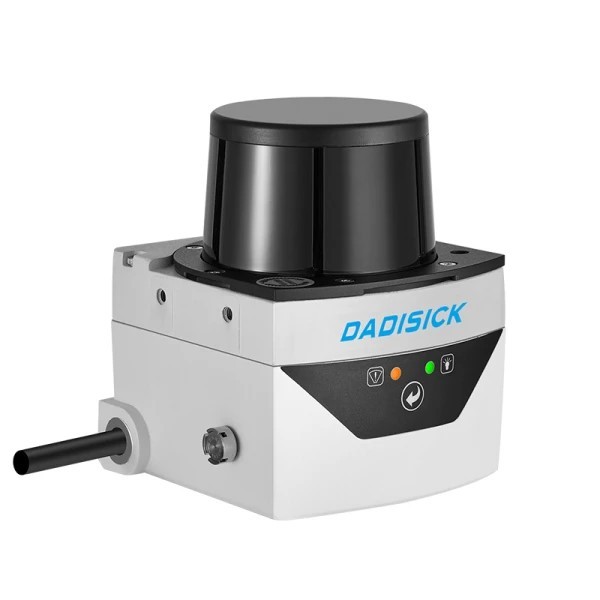
Sensing range 20m, A technique that uses a laser beam to measure distance and create detailed maps of objects and environments.
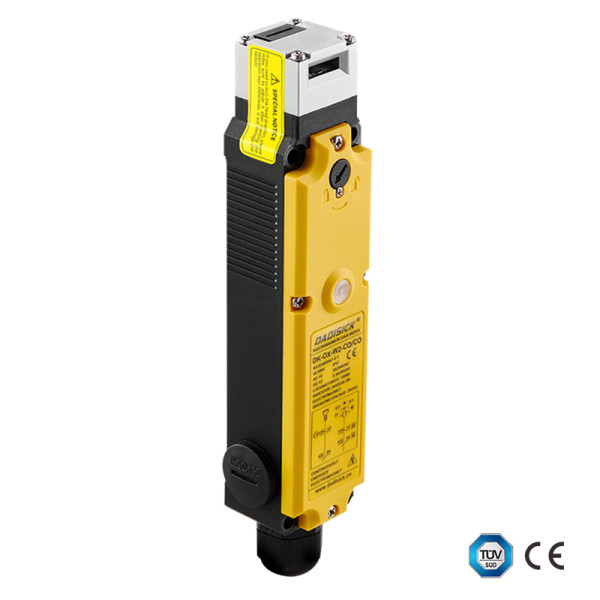
Durable DK-OX-W2 safety interlock switch with mechanical locking and tamper-resistant design, IP67 protection, ideal for machine guards and industrial doors; request a quote or datasheet.
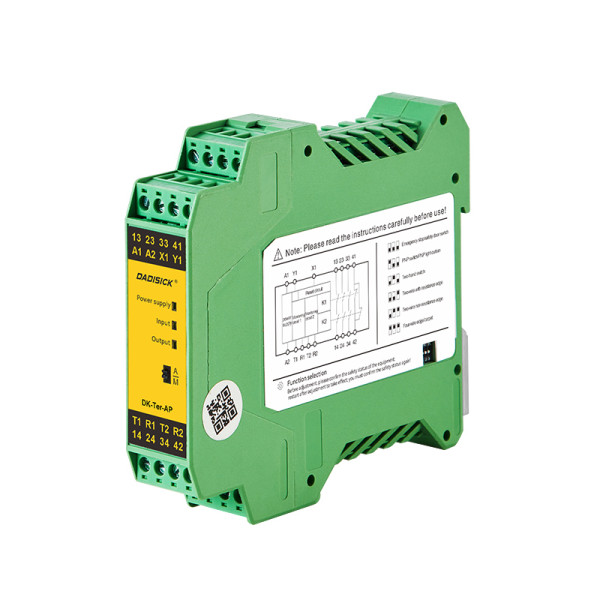
Multifunctional safety relay, providing automatic/manual reset configuration and multifunctional configuration DIP switch, used for industrial field monitoring of various signals with high safety requirements.
Similar Posts You May Be Interested in